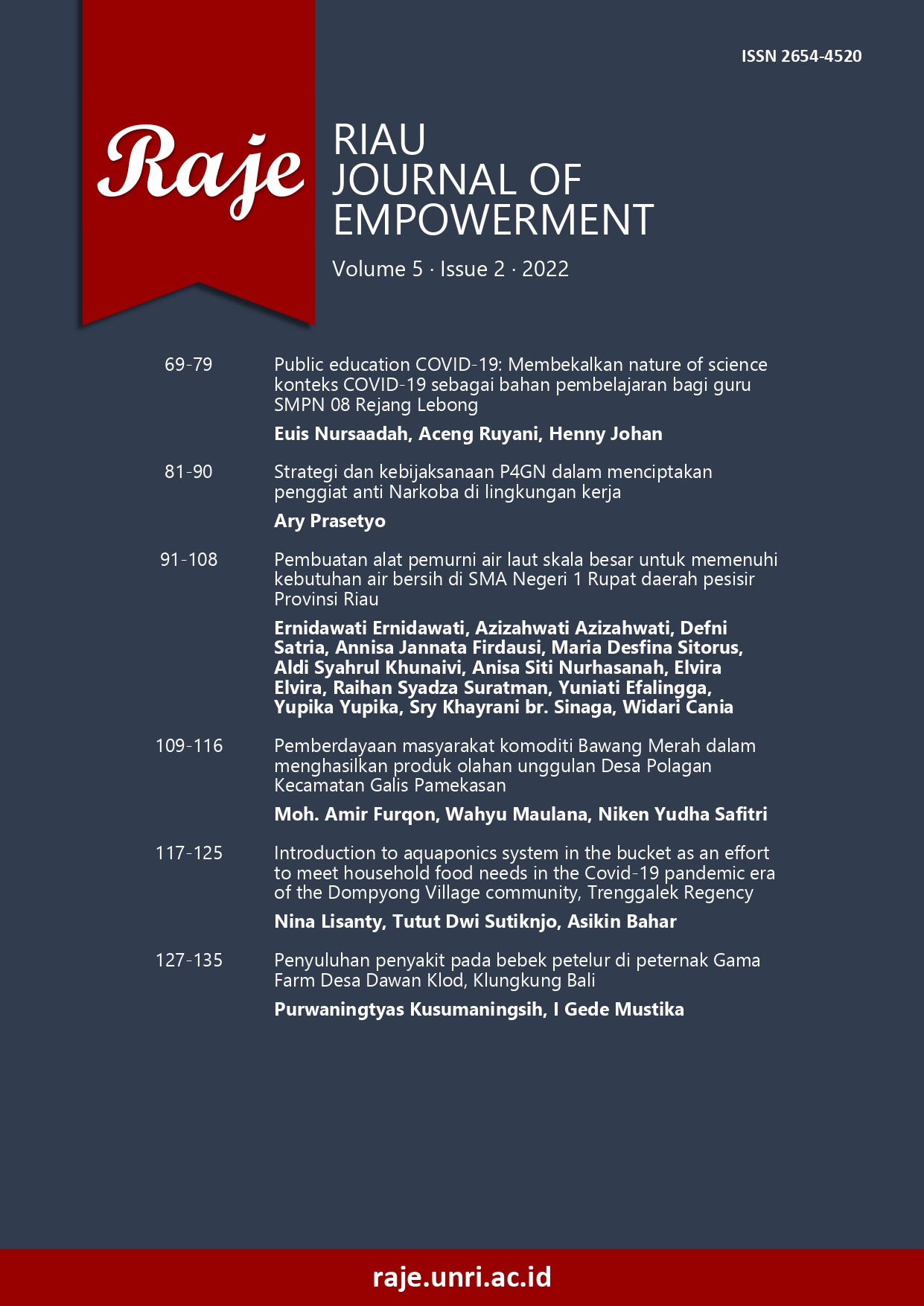
Pemberdayaan masyarakat komoditi Bawang Merah dalam menghasilkan produk olahan unggulan Desa Polagan Kecamatan Galis Pamekasan
Abstract
Horticultural commodities are potential commodities with high economic value and can continue to be developed and shallots are a source of livelihood for the agricultural community. The purpose of this PKM - PM is to provide solutions to maximize potential so that it becomes something of high economic value so as to improve a better standard of living. The partner is the “Sri Kuning” farmer group in the village of Polagan Galis Pamekasan. The PKM – PM method is community empowerment by providing assistance to produce processed products which are the village's superior products. The results of this PKM – PM include: 1. Creating processed products that become the village's superior products; 2. Understanding of digital marketing for marketing expansion; 3. Can determine a competitive selling price; and 4. Utilizing and maximizing the potential of the village so as to create zero waste of raw materials.
Downloads
References
Ab, S., & Hasrida. (2019). Pemberdayaan Petani Bawang Merah Terhadap Kesejahteraan Keluarga Kolai Kabupaten Enrekang. J. Mimb. Sos. 2(1), 1–12. https://journal.uin-alauddin.ac.id/index.php/jmks/article/view/8003
Annisa, I., R. W. Asmarantaka., & R. Nurmalina. (2018). Efisiensi Pemasaran Bawang Merah (Kasus: Kabupaten Brebes, Provinsi Jawa Tengah). Mix J. Ilm. Manaj, 8(2), 254–271.
Aprilani, T. L., & A. Fahm. (2016). Analisis Efisiensi Pemasaran Bawang Merah Di Kecamatan Gerung Kabupaten Lombok Barat. Ganec Swara, 10(2), 26–33.
Apriyanto, C., Sulistiowati., & Hermini. (2013). Kebijakan Pemerintah Daerah Kabupaten Brebes Dalam Pemberdayaan Petani Bawang Merah. J. Polit. Gov. Stud, 2(2), 64-79. https://ejournal3.undip.ac.id/index.php/jpgs/article/view/2152
Asmara, R., & R. Ardhiani. (2010). Integrasi Pasar Dalam Sistem Pemasaran Bawang Merah. Agric. Socio-Economics J, 10(3), 165-175. https://agrise.ub.ac.id/index.php/agrise/article/view/46
Lawalata, M., D. H. Darwanto, & S. Hartono. (2017). Risiko Usahatani Bawang Merah di Kabupaten Bantul. J. Agrica, 10(1), 56-73. https://doi.org/10.31289/agrica.v10i2.924
Parinsi, K. (2017). Analisis Pendapatan Usaha Tani Bawang Merah Di Desa Singki Kecamatan Anggeraja Kabupaten Enrekang. Economix, 5(1), 193–202. https://ojs.unm.ac.id/economix/article/view/5373
Purba, R. & Y. Astuti. (2013). Paket teknologi bawang merah diluar musim tanam di Pandeglang Banten. AGRITECH, 15(2), 105–113. http://dx.doi.org/10.30595/agritech.v15i2.1013
Putrasamedja, S. (2010). Pengujian Beberapa Klon Bawang Merah Dataran Tinggi (Clones Testing of Some Highlands Shallots). J. Pembang. Pedesaan, 10(2), 86-92. http://jurnal.lppm.unsoed.ac.id/ojs/index.php/Pembangunan/article/view/167
Rasoki, T., A. Fariyanti, & A. Rifin. (2016). Pembandingan Efisiensi Pemasaran Bawang Merah Konsumsi dan Benih di Kabupaten Brebes, Provinsi Jawa Tengah. J. Agro Ekon, 34(2), 145–160. http://dx.doi.org/10.21082/jae.v34n2.2016.145-160
Riyanti, L. (2011). Analisis Efisiensi Ekonomi Penggunaan Faktor-Faktor Produksi Pada Usahatani Bawang Merah Varietas Bima Di Kabupaten Brebes. Universitas Sebelas Maret Surakarta.
Susanawati., Jamhari., Masyhuri., & Dwidjono. (2015). Price Behavior and Market Integration of Shallot in Java Indonesia. Int. J. Agric. Syst, 3(2), 193–204. http://dx.doi.org/10.20956/ijas.v3i2.107
Copyright (c) 2022 Moh. Amir Furqon, Wahyu Maulana, Niken Yudha Safitri

This work is licensed under a Creative Commons Attribution 4.0 International License.
Author(s) retain the copyright of articles published in this journal, with first publication rights granted to Riau Journal of Empowerment. All journal content is licenced under Creative Commons Attribution 4.0 International License. This license permits unrestricted use, distribution, and reproduction in any medium, provided the original author and source are credited.